Look, I remember my first arrangement like it was yesterday—sitting across from a venture capitalist at Balthazar in SoHo, trying to act cool while internally panicking about how the actual money part was supposed to work. Do I… just take cash in an envelope like some kind of movie scene? Ask for Venmo like we’re splitting brunch? The awkwardness was real.
Here’s what nobody tells you when you’re starting out: how you handle payments in a sugar arrangement says everything about how safe, sustainable, and drama-free that relationship is going to be. After eight years in this lifestyle—through arrangements in NYC, Miami, LA, and SF with everyone from Wall Street guys to tech founders to entertainment execs—I’ve learned that the cash-versus-digital debate isn’t just about convenience. It’s about protecting yourself, maintaining discretion, and honestly? Not getting screwed over.
So let’s talk about what actually works, what’s genuinely risky, and how to have the money conversation without making things weird. Because trust me, I’ve seen (and experienced) both the smooth systems and the absolute disasters.
Why This Decision Actually Matters More Than You Think
When I started sugaring, I thought payment methods were just a logistical detail—like, whatever’s easiest, right? Wrong. The way money moves between you and your SD reveals everything about the power dynamics, trust levels, and long-term viability of your arrangement.
I learned this the hard way during my second year in the bowl. I had an arrangement with a real estate developer in Miami who insisted on only cash—always. At first, it felt kind of exciting and discreet. But then I realized I had zero paper trail, which made it impossible to show proof of income when I tried to upgrade my apartment. Meanwhile, he had complete deniability if anything went sideways.
That’s when it clicked: the payment method isn’t neutral. It affects your financial security, your legal protection, your privacy, and your leverage in the relationship.
For SDs, the choice often comes down to maintaining discretion—protecting their reputation, their marriage, their business dealings. For us? It’s about safety, consistency, and having evidence that the arrangement exists if we ever need it. These priorities don’t always align naturally, which is why this conversation needs to happen early and explicitly.
The Real Deal on Cash: What They Don’t Tell You
Cash gets romanticized in sugar content—all those images of stacks of bills in designer bags. And honestly? There’s something undeniably direct about it. When a man hands you an envelope at dinner, there’s a tangible acknowledgment of the exchange happening. No apps, no banks, no digital intermediaries.
The genuine advantages of cash:
Complete anonymity for both parties—no transaction records connecting you two through financial institutions. For married SDs or guys in high-profile positions, this is huge. I’ve had arrangements with men in finance where cash was non-negotiable because even a Venmo transaction could theoretically be subpoenaed in a divorce.
Immediate access to your money—no waiting for transfers to clear, no holds, no “business day” BS. You get paid, you can use it that day.
No digital footprint that could complicate things later—whether that’s an SD’s spouse discovering transactions or you dealing with questions about income sources.

But here’s where things get messy, and I’m speaking from actual experience here:
Carrying large amounts of cash makes you a target. I once left a meet-and-greet at The Surf Club in Miami with $3,000 in my bag. Walking to my car, I was hyperaware of every person around me. That anxiety? It’s not worth it. If you’re doing cash, you need a plan for immediately getting it somewhere secure.
There’s zero accountability. If an SD shorts you or claims he gave you more than he did, what proof do you have? I watched a friend get gaslit by her SD who swore he’d been giving her $5K monthly when it was actually $4K—and she had no way to prove otherwise because it was all cash, all verbal.
Depositing large cash amounts raises red flags at banks. Anything over $10K triggers a Currency Transaction Report. Even smaller amounts deposited regularly can look suspicious. I had a banker once pull me aside to ask about my “cash business”—awkward doesn’t begin to cover it.
And let’s talk about the practical annoyances nobody mentions: You can’t pay rent with cash in most upscale buildings. You can’t book nice hotels or flights. You’re constantly breaking bills or making bank runs. It’s just… inefficient for modern life.
According to Dr. Wednesday Martin, anthropologist and author of “Primates of Park Avenue,” “Transactional relationships throughout history have often relied on untraceable exchanges to protect social standing. But this same opacity that provides discretion also removes protections for the economically vulnerable party.” Exactly.
So when does cash actually make sense? For smaller, supplementary amounts—like when he hands you $500 after a great dinner, or covers your shopping as you’re together. For the main allowance? I’ve learned there are usually better options.
Digital Payments: The Modern Approach (With Modern Problems)
Most of my current and recent arrangements have used digital payments, and honestly, once you figure out the right platform, it’s so much smoother. But—and this is a big but—you have to be strategic about which platform and how you use it.
Let me break down what I’ve learned actually works:
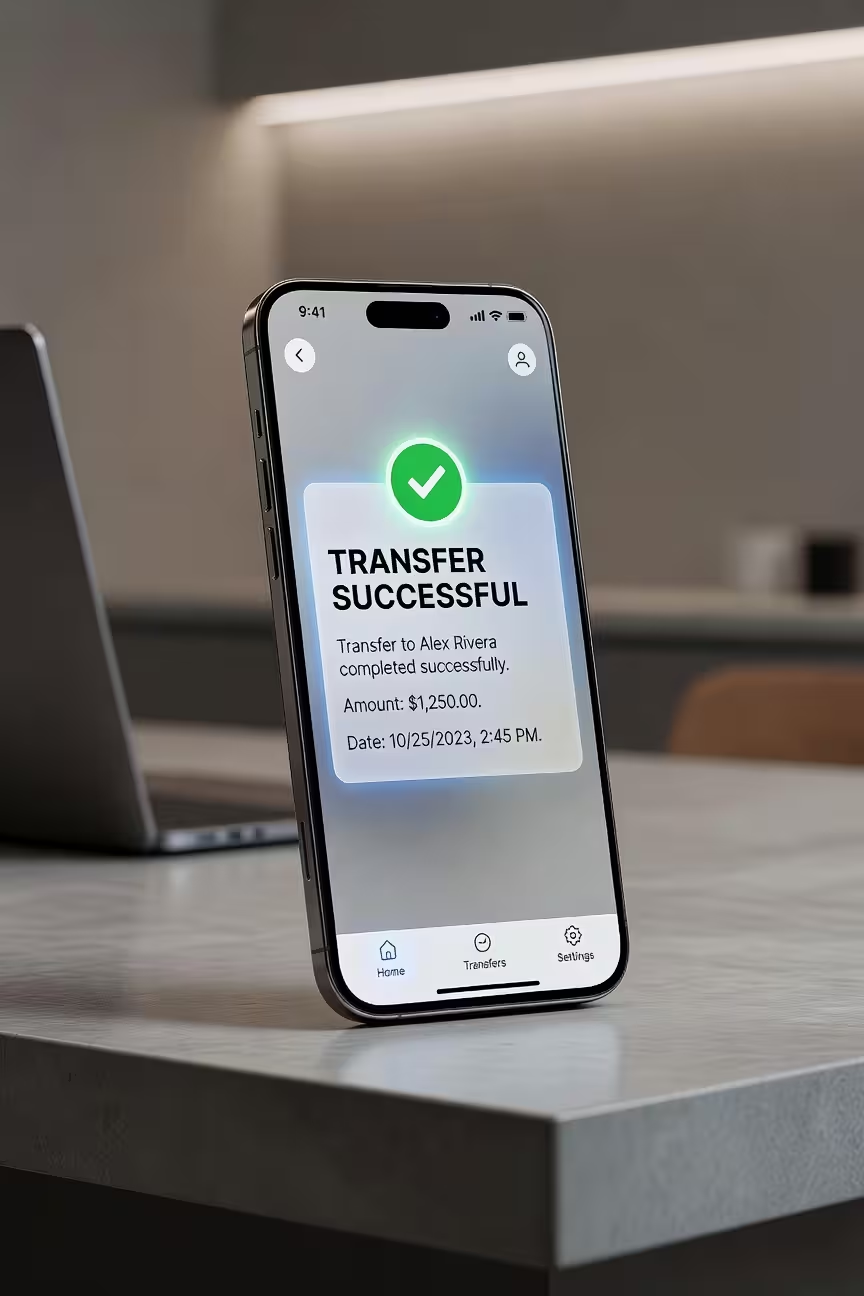
Bank transfers (Zelle, wire transfers, ACH): This is my preferred method for established arrangements with serious SDs. It’s direct, it clears immediately or within a day, and it creates a clear record. I’ve had arrangements where my SD set up automatic monthly transfers—it showed up like clockwork on the first of every month. That consistency? It’s invaluable for financial planning.
The challenge is privacy. Bank transfers obviously show up in both your accounts. For you, this might actually be a good thing—proof of income for taxes, rental applications, whatever. For him, it requires trust that you’re not going to create problems. I’ve only done this with SDs I’d been seeing for several months and who were either single or in open arrangements.
One SD I saw in San Francisco—a founder in his late 40s—was completely open about everything with his accountant and lawyer because his divorce was finalized and he structured our arrangement almost like a consulting agreement. Super transparent, super professional. That’s the ideal scenario for bank transfers.
Cash apps (Venmo, CashApp, PayPal): These are popular because they’re easy and fast. But I have serious reservations about Venmo specifically—it’s too social, too public, too risky. Even with privacy settings maxed out, there’s a social network aspect that feels unsafe for this context.
CashApp is better for sugar arrangements because it’s more anonymous and has a business-account option. PayPal can work but fees are annoying, and they’re known for freezing accounts if they suspect anything they consider “adult services.”
The biggest issue with cash apps? Chargebacks and reversals. I know multiple SBs who’ve had SDs reverse payments after intimacy, claiming it was “unauthorized.” With PayPal especially, they often side with the payer. This is why I never consider payment “real” from a cash app until it’s been transferred to my actual bank and cleared.
Here’s my actual system: If we’re using CashApp, I transfer to my bank immediately and wait three business days before considering that money truly mine. Yes, it’s paranoid. But I’ve been burned once, and once was enough.
Cryptocurrency: I’ve had exactly two SDs suggest paying in crypto—both tech guys, obviously. One in LA was super into Bitcoin and genuinely thought he was doing me a favor by “investing my allowance for me.” Hard pass.
Look, if you’re genuinely knowledgeable about crypto and want to receive payment that way, cool. But for most of us, it adds unnecessary complexity, volatility, and tax headaches. The one advantage is anonymity—crypto transactions are basically untraceable to real identities if done carefully. But converting crypto to actual usable money involves exchanges, verification, fees… it’s a whole thing.
If an SD insists on crypto only, ask yourself why. Is he genuinely just a crypto enthusiast, or is he trying to make it harder for you to access your money? That distinction matters.
The research backs this up. Dr. Helen Fisher, biological anthropologist and relationship expert, notes that “In relationships with financial components, the method of exchange significantly impacts perceived commitment and trust. Traceable transactions signal accountability, while anonymous methods can paradoxically both protect and endanger.”
The Safety Comparison Nobody’s Really Having
Alright, let’s get brutally honest about actual safety—because this isn’t just about convenience or discretion. It’s about protecting yourself from theft, scams, legal problems, and arrangements that go sideways.
Physical safety with cash:
The most obvious risk is carrying large amounts. But there’s another dimension I don’t see talked about enough: cash payments often happen in private settings—hotel rooms, his apartment, his car. This ties financial exchange to physical proximity in ways that can feel coercive.
I remember an arrangement early on where the SD would only give me cash at the end of our dates, always at his place. If things had ever gotten uncomfortable or unsafe, leaving would have meant leaving without payment. That financial dependency in the moment created a power dynamic I didn’t fully recognize until later.
Contrast that with digital payments that can happen before you meet, or from separate locations. There’s a safety in that separation—the financial piece is handled independently from the physical piece.
Of course, this cuts both ways. SDs worry about paying digitally and then being stood up or ghosted. That’s valid too, which is why establishing clear boundaries and building trust gradually is so crucial.
Digital safety concerns:
The big ones are hacking, identity theft, and platform security breaches. If someone gains access to your CashApp or PayPal, they can see your entire transaction history with your SD—amounts, frequency, notes if anyone was dumb enough to put details. That information could be used for blackmail, either of you or him.
I use two-factor authentication on every financial app, and I keep my sugar-related payment apps on a separate email account from my personal one. Is it extra work? Yes. But it compartmentalizes risk.
Then there’s the issue of scams. Fake payment confirmations are extremely common in the sugar bowl. A guy sends you a screenshot of a “pending transfer,” you meet up, get intimate, and then discover the transfer was never real. Or he uses a stolen credit card on CashApp and the payment gets reversed a week later.
My rule: I never consider a digital payment real until the money is in my bank account and has cleared. Screenshots mean nothing. “Pending” means nothing. If he can’t wait for a transfer to clear before we meet, that’s a red flag that he’s not actually serious or is potentially scamming. Learn more about spotting fake SDs before you even meet to avoid these situations entirely.
Legal and tax implications:
This is where digital payments get complicated in ways cash doesn’t. Digital transactions create records that theoretically should be reported as income. Now, I’m not a tax lawyer—you should definitely consult one—but here’s the reality: the IRS can and does track digital payments over certain thresholds.
As of 2024, payment platforms report transactions over $5,000 to the IRS. If you’re receiving regular transfers, that’s going to show up. How you report it is between you and your accountant, but ignoring it is not a strategy.
Some SBs I know report their allowance as “gifts,” which under IRS rules can be non-taxable if they’re truly gifts. Others report it as income. The point is—digital payments force this conversation, while cash lets you avoid it (for better or worse).
My Actual Recommendations Based on Years of Trial and Error
After navigating this through countless arrangements, here’s what I genuinely recommend:
For new arrangements (first 1-3 months): Cash for the initial meet-and-greet or first dates, then transition to a digital method once trust is established. This protects both parties—he’s not sending money to someone he’s never met, and you’re not meeting up based solely on a promise.
But I want to be clear: Never meet someone for the first time expecting cash that day unless it’s in a genuinely public, safe setting. The pressure of exchanging money during a first meeting can cloud your judgment about whether this person is actually safe or right for you. Better to keep the first date purely about chemistry and connection, discuss the arrangement terms including payment method, and then have the financial piece begin after you’ve established he’s legit. Here’s more on staying safe during those crucial first meetings.
For established arrangements (3+ months): I strongly prefer bank transfers or CashApp for the regular allowance. The consistency, traceability, and professionalism just work better long-term. Cash can be supplementary for shopping trips, spontaneous gifts, travel money—but the core financial support should be digital.
One arrangement I had for almost two years—a finance guy in Manhattan—did a monthly wire transfer for the allowance and then would give me cash for shopping when we were together. That hybrid system felt balanced. The allowance was reliable and documented; the cash felt spontaneous and fun.
Red flags to watch for with any payment method:
An SD who keeps changing the agreed-upon method or amount. Consistency matters.
Someone who insists on only one method without being willing to discuss your comfort level. Whether it’s cash-only or crypto-only, inflexibility suggests control issues.
Payment that’s always “next time” or delayed. If he’s real and serious, the financial piece should be as reliable as your time together.
Requests to use sketchy platforms you’ve never heard of, or person-to-person payment methods that seem designed to be untraceable. That’s a scam waiting to happen.
Guys who want to pay you through business accounts or third parties “for tax reasons.” This can actually create legal problems for you.
I also want to address something I see newer SBs struggle with: feeling awkward about discussing payment methods explicitly. Here’s the thing—a real SD expects this conversation. He’s not going to be offended or put off by you asking how payment will work, expressing a preference, or requesting a trial period to build trust.
I’ve had these conversations dozens of times, and the quality SDs appreciate directness. We’ll usually discuss it over text before the first meeting: “I typically do monthly allowance via bank transfer after we’ve met a few times and established we’re a good fit. Does that work for you, or do you have a different preference?”
If that kind of straightforward question scares him off, he wasn’t serious anyway.
Understanding what type of SD you’re dealing with can also help predict which payment method will work best for your specific dynamic.
The Conversation Script That Actually Works
Since I know the “how do I actually bring this up” question is on everyone’s mind, here’s the framework I use—adjusted to wherever you are in the getting-to-know-each-other process:
Before the first meeting (via text or on the platform):
“I’d love to meet for coffee and see if we connect. Just so we’re on the same page, I typically look for [monthly allowance/PPM amount] arrangements. What are you comfortable with, and how do you usually handle the financial side?”
This opens the door for him to explain his preferences. Listen for flexibility and respect. If he’s immediately defensive or vague, that tells you something.
During/after a successful first date:
“I had a really great time today. I think we could have something fun here. Want to talk specifics about the arrangement? I usually prefer [bank transfer/CashApp/whatever] for allowance because it’s consistent for both of us, but I’m open to discussing what works best as we build trust.”
Notice how this frames it as collaborative—”what works best”—while still stating your preference clearly.
If he suggests a payment method you’re uncomfortable with:
“I appreciate you being upfront. I’ve had better experiences with [your preferred method] because [brief reason]. Would you be open to trying that, at least initially while we’re getting to know each other?”
The key is being warm but firm. You’re not being difficult; you’re being smart. If he respects you, he’ll work with you on this. Navigating these conversations becomes easier when you’ve mastered the art of texting confidently without seeming desperate.
If there’s a payment issue (late, wrong amount, etc.):
“Hey, I noticed this month’s allowance didn’t come through as expected. Is everything okay on your end? Want to touch base about it?”
This assumes good intent first, but it also doesn’t let it slide. If it becomes a pattern, that’s when you have a bigger conversation about whether the arrangement is sustainable.
What Actually Makes an Arrangement Sustainable Long-Term
Here’s what I’ve learned after years of doing this: The payment method itself matters less than the consistency, respect, and clear communication around it.
I’ve had cash arrangements that felt incredibly secure because we’d established a rhythm and mutual trust. I’ve had digital arrangements that felt sketchy because the guy was weird about amounts or timing. The method is a tool; the relationship dynamics are what determine safety.
The best arrangements I’ve had shared these elements:
Agreed-upon terms that were actually followed. If we said first of the month via bank transfer, that’s what happened. If we said cash at the end of each date, that’s what happened. Reliability builds trust exponentially.
Willingness to adjust as things evolved. Maybe you start with cash and transition to digital. Maybe the allowance increases as the relationship deepens. The ability to revisit these conversations without drama is huge. That’s where knowing how to renegotiate your allowance becomes essential.
Mutual respect for each other’s concerns. If you’re worried about bank records, he takes that seriously. If he’s worried about privacy, you take that seriously. It’s not adversarial; it’s collaborative.
Backup plans for when things don’t go smoothly. Tech fails. Banks have issues. Life happens. Having a secondary payment method or a clear plan for handling glitches prevents small problems from becoming relationship-enders.
Dr. John Gottman, renowned relationship researcher, found that “successful long-term relationships of all types are characterized by the ability to repair conflicts quickly and maintain positive regard during disagreements.” That applies here too. If a payment issue comes up and you both handle it with maturity and problem-solving rather than blame, your arrangement is probably going to last.
Final Real Talk: Trust Your Gut and Protect Yourself
Look, I’m going to level with you—there’s no perfect, risk-free payment method in sugar relationships. Cash has vulnerabilities. Digital has vulnerabilities. What matters is that you choose what genuinely makes you feel safest and most respected, and that you’re with someone who honors that.
If an SD is pressuring you toward a method that feels unsafe or uncomfortable, or if he’s dismissive about your concerns, that’s not about the payment method. That’s about him not valuing your wellbeing. Move on.
The sugar relationships that have enriched my life—financially, sure, but also emotionally and experientially—have been the ones where we treated each other like full human beings, not just transaction partners. The money part was handled with the same care and respect as everything else.
So yes, think strategically about cash versus digital. Consider the practical safety factors I’ve laid out. But also trust your instincts. If something feels off about how payment is being handled, it probably is.
And remember—you’re not asking for too much by wanting clarity, consistency, and security around finances. You’re asking for the baseline of what any legitimate arrangement should provide. Don’t let anyone make you feel otherwise.
The bowl can be amazing when you’re smart about it, when you protect yourself, and when you’re with people who genuinely want the best for you. The payment method is just one piece of that puzzle—but it’s an important piece that deserves your attention and your advocacy for yourself.
You’ve got this. Stay safe, stay smart, and don’t settle for arrangements that don’t serve you. There are genuinely good SDs out there who will work with you to find payment methods that protect and respect both of you. Those are the ones worth your time.