Look, I’m just gonna say it—the first time I walked into The Carlyle in NYC with a man who’d just casually mentioned his driver was waiting downstairs, I felt like I’d stepped into someone else’s life. The marble lobby, the way the staff knew his name, the champagne that appeared without him even ordering… it was intoxicating. And honestly? That feeling never completely goes away.
But here’s what nobody tells you when you’re new to the bowl: that rush of luxury—the Birkins, the five-star suites, the spontaneous weekends in Tulum—it can become your baseline faster than you think. And then you’re stuck asking yourself the question that keeps so many of us up at night: Can I actually sustain this?
After eight years in this lifestyle—from my early twenties navigating arrangements in Manhattan to now helping women build sustainable sugar careers—I’ve seen every version of how this plays out. Some women ride the luxury wave for a few magical years before reality crashes in. Others build genuine financial empires. And a few… well, they get so addicted to the lifestyle that they make choices they later regret.
So let’s get real about what it actually takes to maintain a luxury lifestyle on sugar income, because the answer isn’t as simple as “find a richer daddy.”

The Luxury Trap Nobody Warns You About
My second year in the bowl, I was seeing a tech founder who’d sold his startup for an eight-figure exit. We’re talking private jets to his Malibu beach house, a standing table at Catch LA, shopping trips where he’d hand his Amex to the Gucci sales associate and tell her to “take care of my girl.”
I got so fucking comfortable with that lifestyle. My apartment was in a doorman building in Tribeca. My closet looked like a Bergdorf showroom. I stopped checking prices at restaurants because… why would I?
Then he met someone he wanted to marry. Which, you know, happens. We’d always been clear this wasn’t forever.
But suddenly I’m staring at a $4,200 rent bill, a closet full of clothes I can’t return, and the crushing realization that I’d let my “backup plan” become “maybe I’ll figure it out later.”
That’s the trap. The girlfriend experience isn’t just about what you provide—it’s about what you get used to providing yourself. And the lifestyle creep is real, babes.
Dr. Helen Fisher, the biological anthropologist who’s studied attraction for decades, talks about how our brains literally rewire around pleasure patterns. She explains that “the brain’s reward system responds to luxury and novel experiences much like it does to addictive substances—creating neural pathways that make returning to a ‘normal’ baseline feel like deprivation rather than normalcy.”
Translation? Your brain doesn’t see dropping from first class to economy as “going back to normal.” It registers it as loss. And that psychological shift changes everything about how you approach arrangements.
What “Sustainable” Actually Means (Spoiler: It’s Not What You Think)
Here’s where most articles about sugar dating get it completely wrong. They focus on finding one mega-wealthy SD who can fund your entire luxury lifestyle indefinitely.
That’s not sustainability. That’s dependency with better shoes.
Real sustainability in this lifestyle looks more like building a diversified luxury portfolio—and yeah, I know that sounds like some finance bro bullshit, but stay with me.
When I finally got my act together after Mr. Tech Founder, I restructured everything:
Primary arrangement: Covered rent, car payment, and a monthly shopping budget. This was my baseline security.
Secondary arrangement: Older gentleman, less frequent (twice monthly), but generous PPM that went straight into investments. He actually encouraged me to build wealth, which… chef’s kiss.
Side hustle: Started consulting other SBs on styling and presentation. Not huge money at first, but it was mine.
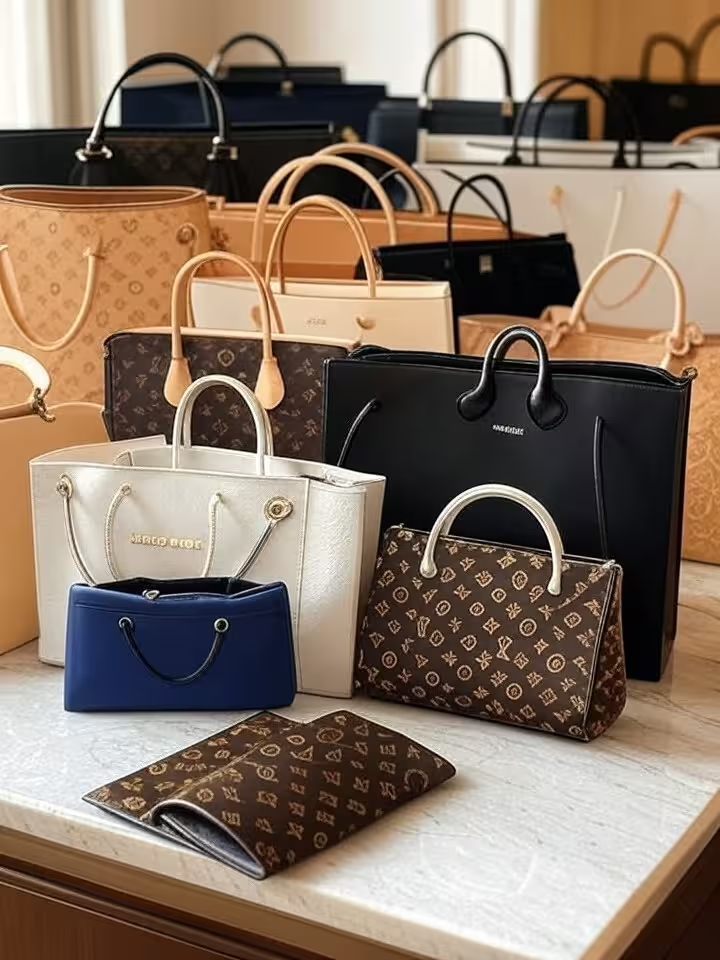
Strategic saving: Every gift that could be liquidated (jewelry, designer bags I didn’t love) got sold. That money funded an index fund that’s now worth more than any single allowance I’ve ever received.
This approach meant I could maintain the lifestyle—the nice apartment, the regular facials at Rescue Spa, the ability to meet an SD at Cipriani without feeling out of place—while building actual financial security underneath.
Was it as glamorous as jetting to Paris every month? No. But could I sleep at night knowing one breakup wouldn’t destroy me? Absolutely.
The Math That Most Sugar Babies Refuse to Do
Okay, real talk time. Let’s actually break down what “luxury lifestyle” costs in a city like Miami, where I spent three years:
Housing (South Beach, nice but not penthouse): $3,500/month
Car payment + insurance (nothing crazy, maybe a C-Class): $800/month
Maintenance (hair, nails, skin, gym): $1,200/month
Wardrobe refresh (staying current): $1,500/month
Dining out/social (because you can’t always wait for SD dates): $800/month
Travel (personal trips, visiting family): $500/month
Miscellaneous (Ubers, subscriptions, life): $700/month
Total: $9,000/month minimum
And that’s not even including savings, investments, or those “oh shit” moments like your laptop dying or needing emergency dental work.
So you need to be clearing at least $10-12K monthly just to maintain what most people would consider a “comfortable luxury” baseline in a major city. In NYC or LA? Add another $3-5K easy.
Now here’s the question nobody wants to ask: How stable is your arrangement income, really?
Because if you’re relying on one SD for all of that, you’re one argument, one business loss, one new wife away from scrambling. I’ve watched too many women—smart, gorgeous, strategic women—end up in terrible arrangements because they were desperate to maintain a lifestyle their income couldn’t actually support.
The Allowance Reality Check
Let’s be honest about allowance ranges, because the internet is full of fantasy numbers:
Major markets (NYC, LA, SF, Miami):
– Average SR allowance: $3,000-5,000/month
– High-end SR allowance: $8,000-15,000/month
– Unicorn tier: $20,000+/month (rare, usually requires near-full-time availability)
Secondary markets (Chicago, Boston, Dallas, Seattle):
– Average: $2,000-4,000/month
– High-end: $5,000-10,000/month
So if you’re in that average range—which most arrangements are—you’re looking at needing at least two solid SDs or a primary plus serious side income to hit that $10K+ sustainability mark.
And before someone comments “just get a richer SD”—sure, Jan. We’d all love to exclusively date billionaires who are generous, attractive, and drama-free. In reality, you’re negotiating between financial security, chemistry, time commitment, and sanity.

The Strategies That Actually Work Long-Term
After watching hundreds of arrangements play out—including my own wins and spectacular failures—here’s what separates the women still living well five years later from those who burned out:
Strategy #1: The 50/30/20 Rule (Sugar Edition)
You know that personal finance rule? It works here too, but modified:
50% to lifestyle maintenance: Rent, car, regular beauty appointments, wardrobe basics. This is your baseline funded by your most stable arrangement.
30% to strategic luxury: The fun stuff—designer pieces, trips, experiences that enhance your SB appeal and quality of life.
20% to building exit velocity: Savings, investments, business ventures, education. This is your fuck-you money.
I didn’t follow this early on, and it cost me. When I finally implemented it during a particularly lucrative year with an entertainment industry SD, I managed to save $40K while still maintaining the lifestyle that kept me attractive in the bowl.
That $40K? Turned into a down payment on a condo that now generates rental income. That’s the kind of move that changes your negotiating position in every future arrangement.
Strategy #2: Luxury Arbitrage
This is my secret weapon, and I’m gonna share it because more women need to know this exists.
Luxury arbitrage means leveraging the perception of luxury to generate actual value. Here’s how:
That Hermès bag your SD bought you? If it’s not your style, sell it to a consignment shop like Fashionphile. You’ll get 70-80% of retail, which is often more than the emotional value of keeping it in your closet.
Business class flights your SD books? If you’re flexible and he books refundable, sometimes you can downgrade to economy and pocket the difference (check the airline’s policy). I’ve made $800 doing this on a cross-country flight.
Luxury hotel stays? Use them to create content (if you’re building a brand), network with other high-net-worth individuals in the lobby/bar, or negotiate future bookings at insider rates once you’ve stayed there on someone else’s dime.
The experience of luxury opens doors. But you don’t have to consume every luxury item to benefit from the lifestyle.
Strategy #3: Build Your Personal Brand (Even If You’re Private)
Look, I’m not saying you need to become an Instagram influencer—plenty of successful SBs maintain complete privacy. But understanding personal brand within the bowl is crucial for sustainability.
Your personal brand is the answer to: “Why you, specifically?”
Early in my sugar career, I was generic hot girl #47. Nice enough, pretty enough, but… replaceable. Then I started leaning into what made me different:
– Actually reading the Wall Street Journal and being able to discuss markets
– Developing a signature style (for me: classic with an edge—think Carolyn Bessette-Kennedy meets downtown cool)
– Becoming the woman who knew the best new restaurants before they got buzz
– Offering genuine intellectual stimulation, not just arm candy
This positioning meant I could command higher allowances and attract SDs who valued long-term arrangements over transactional meetups. Those relationships funded years of luxury lifestyle and gave me breathing room to build other income streams.
As relationship researcher Dr. John Gottman notes in his decades of studying couples: “The most successful long-term partnerships—of any kind—are built on mutual respect, genuine interest, and the feeling that both parties are continuously growing.” That applies to sugar relationships too.

When the Luxury Becomes a Prison
I need to get dark for a second, because this is important.
I’ve seen luxury lifestyle addiction destroy women in this space. And I don’t mean that in some pearl-clutching moralistic way—I mean I’ve watched intelligent, ambitious women make increasingly compromising choices because they couldn’t imagine life without the lifestyle.
There was this SB I knew in LA—we’ll call her Maya—who was living an absolutely spectacular life. Penthouse in Century City, G-Wagon, regular trips to Aman resorts, the whole fantasy. Her SD was a film producer, generous but controlling.
When she wanted to cut back on availability to pursue acting (her actual dream), he threatened to end the arrangement. She stayed. When he started making requests that crossed her boundaries, she convinced herself it was fine because “where else am I gonna get $15K a month?”
Last I heard, she’d aged out of his interest, had no savings, and was struggling to find arrangement income that matched her expenses. The luxury lifestyle she couldn’t let go of had become a cage.
The warning signs you’re heading this direction:
– You justify arrangements you feel uncomfortable in because “the money’s too good”
– You’ve stopped investing in any future outside the bowl
– Your self-worth is completely tied to your ability to attract high-allowance SDs
– You can’t imagine downgrading your lifestyle under any circumstances
– You’re making financial decisions based on maintaining appearances rather than building security
If any of that resonates, pump the brakes. The luxury is supposed to enhance your life, not define it.
The Alternative Path: Strategic Moderation
Here’s the thing nobody wants to hear: you don’t have to live maximum luxury to have a great sugar experience.
Some of my happiest years in the bowl were when I was more moderate. I had a comfortable apartment in a decent neighborhood (not the most prestigious). I bought quality pieces that lasted instead of constantly chasing trends. I traveled to interesting places that weren’t always the most Instagrammable.
And you know what? I was less stressed, more present, and actually enjoying the lifestyle instead of constantly performing it.
There’s a version of sustainable sugar dating that looks like:
– $4-6K monthly allowance that covers rent, savings, and comfortable lifestyle
– Occasional luxury trips/experiences as bonuses, not expectations
– Building a career or business alongside sugar income
– Dating for genuine connection, with financial support as a component
– Having an exit plan that doesn’t involve “marry rich or die trying”
This might not be the champagne-and-caviar fantasy sold on TikTok, but it’s the version that lets you sleep at night and actually builds toward something.

The Mindset Shift That Changes Everything
After eight years, here’s what I’ve finally learned: the luxury lifestyle is a tool, not a destination.
When I was 23, I thought the goal was to lock down the lifestyle forever—to find the arrangement so perfect and lucrative that I’d never have to worry about money again.
Now I understand that the real goal is to use the unique opportunities this lifestyle provides to build something that outlasts any individual arrangement.
That might mean:
– Using sugar income to fund a graduate degree that opens career doors
– Saving aggressively during high-earning years to buy property
– Learning from successful SDs about business, investing, and wealth-building
– Building a network that continues to benefit you long after you’ve left the bowl
– Developing yourself—education, skills, sophistication—in ways that increase your value in all areas of life
The women I know who are actually thriving long-term? They all used sugar dating as a chapter, not a career. The lifestyle gave them breathing room to build something sustainable. And when they eventually transitioned out, they did it from a position of strength, not desperation.
Real Talk: The Five-Year Test
Here’s an exercise I wish someone had made me do when I started:
Imagine it’s five years from now. Your current arrangement(s) have ended. What do you have?
If the honest answer is “a closet full of designer clothes, some good memories, and no plan”—you need to restructure now.
If the answer is “property, investments, a thriving career/business, and the confidence that I can create luxury for myself”—you’re doing it right.
The luxury lifestyle on sugar income can be sustainable, but only if you’re defining sustainability correctly. It’s not about maintaining the same external lifestyle forever. It’s about using this unique window of opportunity to build a foundation that supports you long after the allowances stop.
My Current Reality (Because You’re Probably Wondering)
These days, I still enjoy elements of the luxury lifestyle, but it looks different than it did at 24.
I own my home. My car is paid off. I have investments that generate passive income. I run a legitimate business helping other women navigate this space strategically. I occasionally date in the bowl, but it’s purely optional—I don’t need the income, which ironically makes the arrangements better.
Could I afford the same level of luxury I experienced during my peak earning years in sugar? Probably not. But I can afford my own life, on my own terms, without depending on anyone. And honestly? That feels more luxurious than any first-class flight ever did.
The question isn’t whether you can maintain a luxury lifestyle on sugar income. The question is: what are you building while you have access to it?
Because the women who treat this lifestyle as a strategic opportunity? They end up just fine. The ones who treat it as a permanent solution? They struggle.
So yeah—live it up, enjoy the champagne, wear the Louboutins, travel to Santorini. But for the love of god, also set up that retirement account, build that side hustle, and invest in a version of yourself that doesn’t need a sugar daddy to live well.
That’s the real luxury: freedom. And it’s the only kind that’s truly sustainable.